Starterkit Quicksteps
The Starterkit STKLS102xA consisting of the TQMLS102xA module and MBLS102xA mainboard is intended as evaluation platform for the TQMLS102xA. To bring up the board a comprehensive set of accessories is supplied with the kit. The STKLS102xA is delivered preconfigured to boot the latest released Linux BSP revision at the time of delivery, so only the Host Computer has to be set up properly to bring the STKLS102xA up. This page guides through the first steps with the STKLS102xA Starterkit.
Setup Host Computer
Serial Driver
The TQMLS102xA debug UART is connected via RS232 to X5 on the MBLS102xA. A micro-USB/USB-A cable for the connection to the host PC is part of the STKLS102xA accessory set. Depending on the host operating system, the USB-to-serial converter driver may need to be installed.
Terminal Emulator
Linux
Minicom
Minicom is a command line based serial terminal for serial communication with hardware like our starterkits.
Install Minicom using APT(Debian/Ubuntu)
$ sudo apt install minicom
In order for the terminal to work properly with full rights you need to add your user to the dialout group:
$ sudo usermod -a -G dialout $USER
Connect Starterkit to Host
To determine the serial device name under linux you can use dmesg. Just run the command below and then plug in the starter kit to see the new detected interface names:
$ dmesg -w
Once the interface name is clear you can abort dmesg with ctrl + c.
Now you can start minicom via the command line interface:
$ minicom -D /dev/ttySx
Configure minicom
The serial configuration should be correct by default. However, hardware flow control must be disabled for some starter kits, otherwise the communication works only in one direction.
- Press CTRL + A, then press O to open the configuration menu
- Go to Serial port setup
- Press F to change Hardware Flow Control to No
- Hit Return key
- Select Save setup as dfl to save this configuration as default
- Press ESC to exit the menu
Now you should be able to communicate with the starter kit

Windows
TeraTerm
TeraTerm is an open source terminal emulator for windows. It can be downloaded here.
Configure TeraTerm
- Download and install TeraTerm
- Start TeraTerm and open the Serial Port Settings
- Select your serial port and configure it with the values defined in the chapter Serial Configuration
- After passing the values click on the button New Setting
Now TeraTerm should be ready for use with our starter kits.

Host PC Serial Port Configuration
The serial port which connects the STKLS102xA to the Host PC must be configured as follows:
| Baud rate: | 115200 |
|---|---|
| Data bits: | 8 |
| Parity: | none |
| Stop bits: | 1 |
| Handshake: | XON/XOFF |
Connecting the Starterkit to the Development Host
Please follow the quick start guide delivered with the kit, or open it from the following link: Quick start guide
Linux
BSP Login Credentials
As soon as logging in on the Linux shell for the first time, the question about the login credential comes up.
By default the user root is used to log into the Linux shell, no password is set for user root.
tqmaxx-mbaxx login: root
Testing Interfaces on STKLS102xA
To get familiar with the interfaces of the STKLS102xA we recommend to work through the interface tutorials first.
Building the BSP
The Board Support Packages provided by TQ may not contain all software packages to evaluate the STKLS102xA, therefore TQ provides some guides how to build the BSP and customize it for your needs:
In addition to the BSP documentation, the Yocto SDK build and Eclipse IDE setup for the STKLS102xA is also documented.
Setup Starterkit for different boot sources
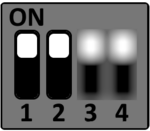
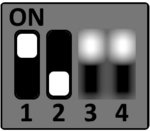
The STKLS102xA can be setup to boot from different sources. Please see the DIP switch settings below to change the boot source.
Boot Device Selection (S3)
To select the desired boot medium set the DIP switches S3, S9 accordingly
SD-Card
S3
eMMC
S3
QSPI NOR
S3
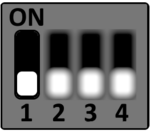
S3-2 ON: TQMLS102xA without eMMC
S3-2 OFF: TQMLS102xA with eMMC
CPLD Function Selection (S9)
S9 DIP switch 1 + 2
| S9 | DIP 1 | DIP 2 |
|---|---|---|
| HDMI | ON | ON |
| LVDS | OFF | ON |
| UCC | ON | OFF |
| LVDS_RGBINV | OFF | OFF |
S9 DIP switch 3 + 4
| S9 | DIP 3 | DIP 4 |
|---|---|---|
| EC1 | ON | ON |
| CAN1 / CAN2 | OFF | ON |
| SAI1 / SAI2 | ON | OFF |
| Reserved | OFF | OFF |
If DIP S9 is not set to one of the CPLD mux modes #1 - #12, the CPLD firmware selects mux mode #1.
| Function | S9-1 | S9-2 | S9-3 | S9-4 |
|---|---|---|---|---|
| #1 EC1 + HDMI | ON | ON | ON | ON |
| #2 EC1 + LVDS | OFF | ON | ON | ON |
| #3 EC1 + UCC | ON | OFF | ON | ON |
| #4 EC1 + LVDS_RGBINV | OFF | OFF | ON | ON |
| #5 CAN + HDMI | ON | ON | OFF | ON |
| #6 CAN + LVDS | OFF | ON | OFF | ON |
| #7 CAN + UCC | ON | OFF | OFF | ON |
| #8 CAN + LVDS_RGBINV | OFF | OFF | OFF | ON |
| #9 SAI + HDMI | ON | ON | ON | OFF |
| #10 SAI + LVDS | OFF | ON | ON | OFF |
| #11 SAI + UCC | ON | OFF | ON | OFF |
| #12 SAI + LVDS_RGBINV | OFF | OFF | ON | OFF |
| #13 - #16 reserved | / | / | OFF | OFF |
Functional DIP Switches
DIP-Switch settings for CAN and RS485.
CAN configuration (S2)
DIP switch S2 is used to configure the CAN interfaces CAN1 and CAN2.
| DIP | OFF (default) | ON |
|---|---|---|
| S2-1 | CAN0 not terminated | CAN0 interface terminated (120Ω) |
| S2-2 | CAN1 not terminated | CAN1 interface terminated (120Ω) |
RS485 configuration (S1)
DIP switch S1 is used to configure the RS485 interface.
| DIP | OFF (default) | ON |
|---|---|---|
| S1-1 | RS485 RxD not terminated | RS485 RxD terminated (120Ω) |
| S1-2 | RS485 TxD not terminated | RS485 TxD terminated (120Ω) |